
Achilles heel surgery
Surgery on the Achilles heel region, from tendon repair to the removal of calcifications: when it is indicated, how to prepare and what recovery involves.
By Dr. Luigi ManziUpdated on
One of the most delicate and critical parts of the human body is the Achilles heel or, to be more precise, Achilles tendon.
As a tendon that connects the heel bone to the calf muscles, the Achilles tendon is crucial to the body's overall mobility, allowing us to walk, run, and jump. It is precisely this invaluable function that makes it not only valuable, but also extremely vulnerable.
Prone to injury and pathology, the Achilles heel may require not only treatment and prevention, but also, sometimes, surgery.
In the following post, we will discover together what Achilles heel surgery consists of , how to prepare for the procedure, and how to deal with post-operative recovery.
When is Achilles heel surgery necessary?

As mentioned, the Achilles heel is particularly vulnerable , making it prone to inflammation, injury, or even fractures and breaks.
But is surgery always necessary?
Of course not! You must first assess the severity of the situation and then decide whether or not to opt for surgery.
So, when is it necessary to undergo Achilles heel surgery?
It is recommended to undergo Achilles heel surgery mainly in two cases:
- when i conservative treatments fail;
- in case of complete tendon rupture.
In the second case we are faced with the result of a probable acute trauma , caused by external intervention (such as an accident involving the heel), or due to excessive physical activity and effort.
In fact, Achilles heel problems are very common, especially among athletes who, by putting a lot of physical strain on their bodies, are more prone to heel deterioration or injury. This doesn't mean that even non-professional athletes can't suffer from Achilles heel problems.
In fact, people between the ages of 30 and 50 who practice healthy physical activity but do not take the right precautions to protect the health of their heel are prone to Achilles heel problems .
Ultimately, when a serious injury or tear of the Achilles heel occurs , surgery is the only solution to the problem.
Types of Achilles heel surgery
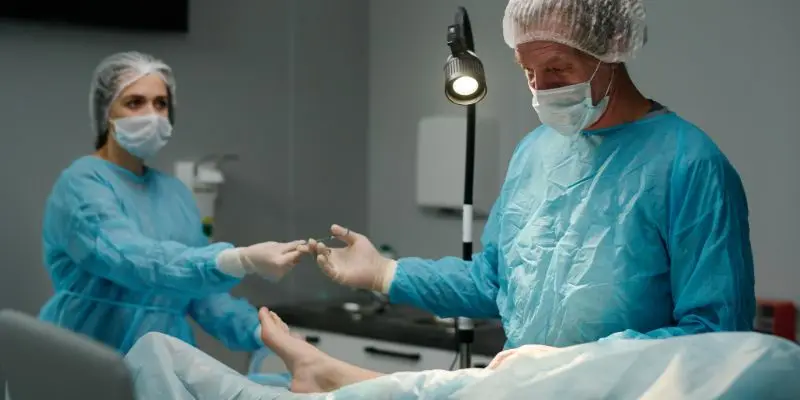
Once you have opted for Achilles heel surgery , you will also have to choose what type of surgery to undergo.
By relying on a specialized surgeon, he will explain and advise you on the choice between two main types of Achilles heel surgery.
The two main surgical approaches are:
- La minimally invasive surgery;
- The open-air surgery.
Minimally invasive surgery
Minimally invasive surgery , which has developed especially in recent years, by its very definition, consists of operating on the affected part without the need to make large incisions.
Minimally invasive surgery , which has become very popular , uses specialized techniques and instruments to repair the Achilles tendon; the surgeon, thanks to the latest generation of instruments, will be able to operate by making only small incisions that usually do not exceed 3 cm.
The advantages of undergoing this technique should not be underestimated. Minimally invasive surgery significantly reduces the risk of postoperative infections , while also reducing trauma to the affected tissue, and ensures rapid postoperative recovery.
Open-air surgery
This other Achilles heel surgery technique, however, is more traditional and invasive.
Open Achilles heel surgery involves a 10-15 cm incision along the affected portion of the tendon. Once the incision is made, the surgeon will repair the tendon with a wide range of motion.
As mentioned, this technique is considered more invasive than the minimally invasive technique; this carries a higher risk of infection and longer recovery times than modern techniques.
Preparing for surgery and what to expect

After choosing which Achilles heel surgery to undergo, it will be essential to consult with your surgeon once again to best prepare for the procedure.
The medical procedure requires, first of all, a thorough study of the heel pathology and the patient's general health . For this reason, the surgeon will request all the necessary pre-operative tests , including blood tests , ultrasounds , and MRIs.
Before undergoing the actual operation, you will also be required to fast for at least 6-8 hours , which will then be followed by anesthesia.
Anesthesia can be local or general , depending on the type of surgery chosen and the severity of the situation.
In addition to knowing that the operation can on average last from 30 to 60 minutes , it is always a good idea to organize the return home as well as possible : never show up at the hospital without first making sure that you can return home safely.
Possible complications and risks

No surgical procedure is free of risks and complications. Even Achilles heel surgery, therefore, presents some.
Among the most probable and widespread complications of this surgery , it is worth mentioning:
- healing problems;
- infectioni;
- imperfect tendon healing;
- a further rupture of the tendon.
These risks and complications, however, should not frighten the patient and lead him to give up on the operation.
Thanks to constant monitoring and post-operative indications provided by the surgeon , the probability of developing complications and other problems is significantly reduced.
In fact, if during post-operative recovery, symptoms develop , such as fever , swelling or persistent pain , by immediately alerting your doctor and following his instructions, you will be able to recover as best as possible and avoid risks and complications.
SmartHallux: The best choice for Achilles heel surgery

We've learned how to best approach Achilles heel surgery, thanks to the support of experienced surgeons who are dedicated to patient care.
But who should you turn to, specifically, to be sure you're in safe and expert hands?
SmartHallux is the answer to your worries.
The team of SmartHallux professionals , experts and competent in patient care and in the use of cutting-edge technologies, follows the guidance of Dr. Luigi Manzi , a surgeon with extensive experience and international fame.
Specializing in foot and ankle care , SmartHallux offers personalized solutions and cutting-edge approaches to ensure the complete resolution of any podiatric pathology.
If you want expertise, safety, quality, and professionalism, SmartHallux is for you.
Don't let an Achilles heel injury or injury dictate and limit your life! Trust the best in the industry: click here and book your initial consultation with SmartHallux.