
Flat Foot Surgery: How to Restore Foot Function
Flat foot surgery is considered when insoles and physiotherapy no longer control pain. The techniques, from tendon transfers to osteotomies, and the recovery.
By Dr. Luigi ManziUpdated on
Flat foot disease is considered debilitating because the arch of the foot is very small or even absent . This article, entitled “Flat Foot Surgery,” explains how to resolve this condition once and for all.
This condition involves almost total contact between the sole of the foot and the ground , which damages not only the foot itself, but also the legs, posture and back.
Flat feet are a condition that can be congenital or acquired , but in either case, this annoying and debilitating condition must be addressed.
Let's discover together how to say goodbye to flat feet and live a healthy, happy life, analyzing the various options and identifying the specialists to turn to.
Diagnosis of Flat Foot

To resolve the problem as quickly as possible and decide on the appropriate approach, a diagnosis of flat feet is essential.
People usually go to the doctor after noticing the telltale symptoms of flat feet.
In fact, if you experience swelling , pain, or difficulty moving your foot or ankle , you should always see your doctor and find out what the problem is.
By contacting the doctor, he will perform the diagnostic test.
The diagnostic test for flat foot consists of:
- Start with the study of the patient's medical history: to find out if he is already subject to any foot and ankle pathologies;
- Do a detailed physical examination: the doctor examines the affected part in detail, proceeding, if necessary, also to a tactile examination to test the patient's pain;
- Use of specific diagnostic tests: which X-rays and ultrasounds; in fact, only with these tests will it be possible to see and confirm any inflammation and lesions.
It is extremely important to diagnose flat feet early so that you can intervene as soon as possible and choose which of the various approaches and treatments for healing is most appropriate.
How to treat flat feet?

There are two main approaches to healing flat feet: conservative treatments and surgery.
The former are considered minimally invasive because they involve practices and habits that can be done and implemented at home without disrupting one's daily routine. Physiotherapy, targeted exercises, anti-inflammatory medications , and the use of insoles are the main treatments recommended by doctors.
All of this is aimed, if not at restoring the correct conformation of the arch of the foot, at least at safeguarding the remaining health of the foot and fighting pain on a daily basis.
Sometimes, however, conservative treatments fail.
And what to do when the problem persists and life gets worse?
Doctors propose and recommend surgery . It will be the doctor who, together with the patient, will explain and evaluate the best procedure , based on the severity of the condition, as well as the patient's expectations and general health.
Flat Foot Surgery: When Conservative Treatments Fail
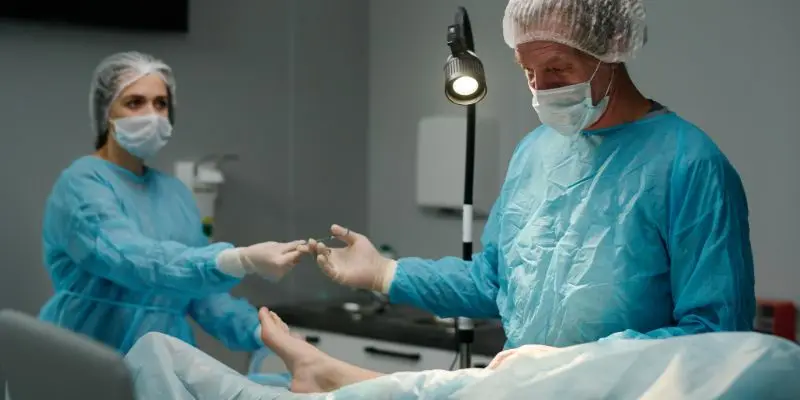
Depending on the severity of the pathology , the patient's needs , as well as his expectations for recovery and recovery , flat foot surgery can vary greatly.
In fact, there are many types of surgical intervention for flat feet that can be chosen.
It is worth listing and explaining what the most common techniques are and their advantages.
Arthrodesis
It involves fusing certain bones to correct a defect in the arch of the foot. This technique offers a permanent solution that not only improves stability but also significantly reduces pain, improving quality of life.
Osteotomy of the calcaneus and first cuneiform
It involves cutting and repositioning the heel bone and a bone in the midfoot , the calcaneus and the first cuneiform. This procedure's primary goal is to realign the foot , or at least improve its alignment. Thanks to the osteotomy of the calcaneus and first cuneiform, pain will be reduced, foot posture will improve, and it also helps protect the joints from wear and tear.
Ligament reconstruction
Not only reconstruction, but also ligament repair . This procedure, in fact, involves both the reconstruction of the damaged ligaments and their repair (if the damage allows it). This operation serves to improve the alignment and stability of the foot , reduce the risk of developing other problems, and safeguard the overall health of the foot.
Tendon Transposition
This procedure specifically targets the movement of the tendons in the arch of the foot . This technique uses the tendons to support the arch of the foot , allowing it to perform its normal function. Tendon transposition corrects flat feet by working on the arch of the foot, restoring the anatomy and preventing pain.
The Importance of Rehabilitation

After undergoing the chosen flat foot surgery , it will be essential and indispensable to follow the post-operative rehabilitation.
This phase is crucial for the success of the surgery and for achieving the desired results, namely complete recovery and a return to daily life.
What to do during the rehabilitation period is always agreed upon with the attending physician , and never decided independently without a thorough consultation.
Rehabilitation begins with a mandatory period of rest , obviously always agreed upon with the doctor and decided based on the severity of the situation.
After the rest period, during which ice packs and painkillers may be used , we will begin with light mobilization and strengthening exercises. These exercises will gradually become more intense and functional for healing, always based on the patient's recovery time.
Once the foot appears to have regained proper mobility, under medical supervision , you can begin to resume your daily activities. This will likely occur within 6 to 8 weeks.
If, however, you want to do more strenuous activities, such as physical activity or various types of exertion, you will have to wait 3 to 6 months to avoid risks.
The key is to always follow the advice of specialists and avoid taking unnecessary risks by taking initiatives not approved by your doctor.
Why choose SmartHallux?

Among the most innovative and advanced interventions for flat feet, the one studied and developed by SmartHallux stands out.
The SmartHallux technique is known for its minimally invasive approach that uses the most innovative, state-of-the-art instruments. Thanks to these tools, SmartHallux surgeons can make small incisions for surgical intervention. This helps make the procedure as minimally invasive as possible.
The natural consequences of a minimally invasive procedure like this are:
- reduced post-operative recovery times;
- significant reduction, if not disappearance total, of the pain;
- minimal presence of scars (only mini-incisions having been made).
Book your SmartHallux visit now

If you suffer from foot and ankle problems , don't neglect your health and turn to the best orthopedic surgeons.
SmartHallux specialists can help you with this, ensuring professionalism and assistance.
What are you waiting for then?
Book your appointment with SmartHallux!
Click here and fill out the small booking form.
Don't neglect the health and well-being of your feet. Book your appointment with SmartHallux now and start taking care of yourself, your feet, and your ankles.