
Pain under the foot after running: what you need to know
Pain in the sole of the foot after running can come from plantar fasciitis, metatarsalgia, a stress fracture or the wrong shoes. The causes and what to do.
By Dr. Luigi ManziUpdated on
Have you come back from a good run and feel that annoying pain in the sole of your foot?
You're not the first. In my office, I see runners with this problem practically every week. The good news? In most cases, it's nothing serious. The not-so-good news is that if you ignore it, it could worsen and keep you away from running for months.
You've probably heard people say, "It's normal, it'll go away on its own." Well, it's not always that simple. Pain in the sole of your foot after running can have a variety of causes, and understanding yours is crucial to getting back to running without problems.
What really happens when the sole of the foot hurts?
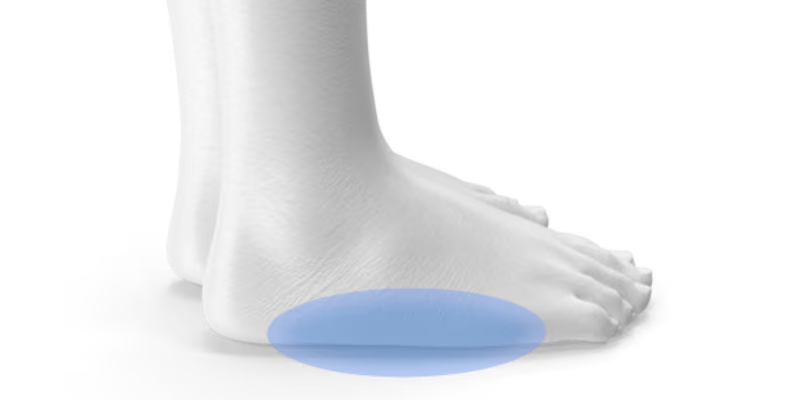
Think of the sole of your foot as a complex structure. It has muscles, tendons, ligaments, and that famous plantar fascia that everyone mentions but few truly understand.
When you run, every time your foot hits the ground, this structure has to absorb an impact that can be up to 3-4 times your body weight. Impressive, right? Our feet are designed to do this, but sometimes something goes wrong.
The arch of the foot, in particular, does an incredible job. It's like a natural spring that compresses and releases with every step. But if we overstress it, or if it's not in optimal condition to function, pain sets in.
The most common causes I see in my office

Plantar fasciitis is definitely first on the list. It's the inflammation of that band of fibrous tissue that runs from the heel to the toes. "Doctor, it's torture when I get my foot out of bed in the morning"—that's the phrase I hear most often. The pain is typically worse after rest and tends to improve (temporarily) with movement.
But it doesn't end there. Stress fractures are more common than you think, especially if you've suddenly increased the intensity of your workouts. They are small cracks in the bone that form when bone tissue fails to repair the micro-damage caused by repeated stress.
Morton's neuroma is another classic. It gives you a very strange sensation, as if you always have a pebble in your shoe, between your third and fourth toes. It's the thickening of a nerve that runs between the bones of the foot.
Then there's metatarsalgia—pain at the base of the toes. It's often linked to improper footwear or poor weight distribution while running. After all, if you consider that every kilometer you run represents about 1600–1700 steps, you understand how important it is for everything to function perfectly.
Ill-fitting shoes are a very common cause. The other day, a runner came to me wearing three-year-old shoes. “But they still look great!” he said. Too bad the cushioning was completely gone.
What pain feels like: what you tell me

Pain in the sole of the foot has some fairly typical characteristics.
It often begins as a dull ache, perhaps in the hours following a run. "Doctor, I was fine last night, but this morning..." This is the classic story. The pain can be localized or widespread, sometimes stabbing, other times deeper.
Morning stiffness is an important sign. If the first steps of the day feel like agony, we need to investigate. The foot, after hours of nocturnal immobility, "stiffens" and complains when you put it back into action.
Many patients also describe a feeling of tension along the arch of the foot after running, as if something were pulling too hard. This is a symptom that shouldn't be underestimated.
Pain to the touch is another important diagnostic feature. If you press your toes on the sole of your foot and it hurts in specific spots, that tells me a lot about what it might be.
How do I diagnose?

When you come to my office, the first thing I do is listen. Really. You tell me when it started, how the pain manifests itself, what makes it worse, what improves it. These details are worth more than many tests.
Then I examine you. I look at how you place your foot, how you walk, check the flexibility of your toes, and feel the painful areas. Sometimes, even right there, I have a pretty clear idea of what we're dealing with.
Tests? They're not always needed right away. If I suspect a stress fracture, then yes, an X-ray is needed, perhaps an MRI. For plantar fasciitis, an ultrasound is often sufficient. But we never start with the tests—we always start with you and your history.
A gait analysis can be very helpful, especially if the problem recurs. Seeing how you run tells me a lot about where the problems might be arising.
What can we do to solve the problem?

Rest is always the first "medicine." I know, it's not what you want to hear, but if you keep running on a sore foot, you risk making everything worse.
Ice can help for the first 48 hours, especially if there's inflammation. Don't leave it on for too long; 15-20 minutes is enough. Painkillers can provide relief, but remember that they only address the symptom, not the cause.
The right shoes make all the difference. There's no perfect shoe for everyone, but there is one that's right for you. Sometimes, just changing them can solve most of the problem.
Custom insoles are a powerful tool. Not the ones you find in the store, I mean the ones custom-made after a thorough biomechanical assessment. They can literally change the way your foot works.
Physical therapy is essential for many of these conditions. Specific stretching, strengthening exercises, and manual therapy all contribute to recovery. And no, those three exercises you saw on YouTube aren't enough.
In more resistant situations, we sometimes consider cortisone injections or other therapies. But they're always a last resort, not the starting point.
When to Get Back to Running (and How to Do It Right)

The question you all ask me: “When can I start running again?”
There's no one-size-fits-all answer. It depends on the cause, how severe it is, and how you respond to treatment. But there's a golden rule: if you walk pain-free for a week, we can start thinking about a gradual return to running.
Gradual is the key. You can't stop for three weeks and then pick up where you left off. Your body needs to gradually reacclimate itself.
I usually recommend a running-walking program for the first few weeks. Then, gradually, you can extend the running phase. The important thing is to listen to the signals your body is sending you.
How to prevent it from happening again
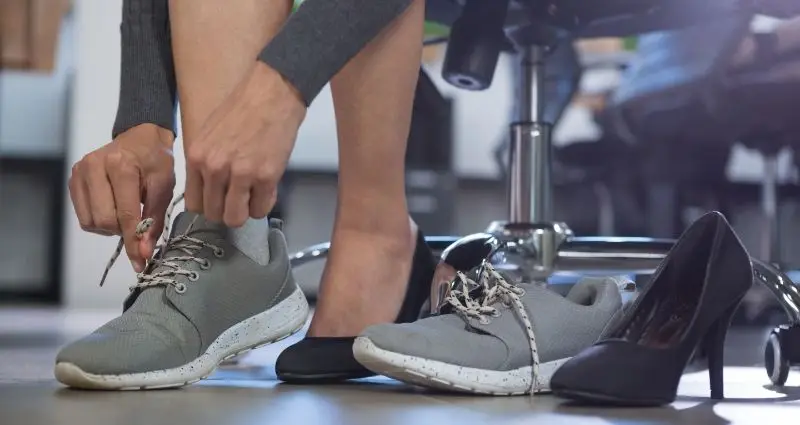
Prevention starts with your shoes. Change them regularly—about every 500-800 kilometers, depending on your type of running and your weight.
Stretching isn't optional, especially for the calf and plantar fascia. Ten minutes a day is enough, but done well and consistently.
Gradual increase in load is crucial. The 10% rule (never increase distance and intensity by more than 10% per week) is no myth.
Listen to your body. That discomfort you think will go away on its own? Maybe it's better to take an extra day off. It's always better to skip a workout than miss three months of your season.
SmartHallux: Where we can help you

Here at SmartHallux, we specialize in foot and ankle surgery. Dr. Luigi Manzi, who has extensive experience in this field, provides each patient with a personalized treatment plan using the most modern techniques.
From biomechanical analysis to the most advanced treatments, our approach is always personalized. Because every foot is different, and every runner has their own characteristics.
The SmartHallux team treats conditions such as hallux valgus , Morton's neuroma , and other deformities that cause foot pain. Providing comprehensive support throughout the treatment process, SmartHallux can be a winning choice for effective treatment tailored to your needs. Book your specialist consultation with the SmartHallux team now (opens in a new tab).
Questions you often ask me
Is foot pain after running normal?
Common, yes, normal, no. It's true that many runners experience it, especially when they start or change their training routine. But pain is always a sign that something is wrong. Don't ignore it.
Can I keep running if it hurts a little?
It depends. A slight discomfort that goes away when you warm up *might* be acceptable for a few days. Pain that worsens while running or persists even when you rest? Stop immediately.
How long does it take to heal?
Plantar fasciitis can last from a few weeks to a few months. Stress fractures usually last 6-8 weeks. But every case is different. The important thing is not to rush it—it's better to heal well once than to keep relapsing.
Do I have to stop running?
Not necessarily forever, but a break is often needed. The time you "waste" now will be made up for when you can run without pain and without fear of the problem returning.