
SmartHallux® Method
Smarthallux explains to you
Childhood pronation syndrome or flat foot
What does pronatory syndrome or flat foot mean?
Pronation syndrome, also known as flat foot or pronated valgus foot, is a very common alteration of the shape of the foot, especially during development.
Scientific articles in the most prestigious international journals tell us that newborns are born with flat feet, and the normal arch may not fully develop until the child reaches the age of 7-10.
One of the most authoritative studies , conducted on 835 children, highlighted how the presence of a flexible flat foot was detected in 54% of children up to 3 years of age, while the percentage dropped to 24% for those aged between 3 and 6 years.
Furthermore, it should be noted that overall only 1% of these flat feet were classified as “pathological”.
Pathological flatfoot can lead, in adulthood, to more serious problems such as a lesion of the posterior tibial tendon or a pathology affecting the subtalar and talonavicular joints and, in the most serious cases, to repercussions also affecting the knee, hip and back.
What causes flat feet?
Pronation syndrome in children or flat foot in itself does not represent a pathology.
During growth, flat feet probably represent an evolutionary advantage linked to the presence of a wider support base.
Flat foot is therefore a multifactorial pathology, due to both genetic causes and environmental factors.
Having flat feet, therefore, often does not cause any serious symptoms other than a typical gait with the feet "rolling" outwards and greater wear of the shoes on the inside.
The correct age for a specialist visit is, therefore, generally between 6 and 8 years.
If surgery is recommended for flat feet in children, the correct age to perform it is between 10 and 12 years old, before the foot is fully developed so as to exploit the residual growth to "guide" its growth and correct the deformity.
Are there shoes or insoles for children with flat feet?
There are no effective shoes or insoles to cure flat feet, so there's no point in torturing our children with orthopedic shoes or insoles or exercises on tiptoe or any other kind of exercise.
As mentioned, in most cases the foot will heal on its own. In the remaining cases, minimally invasive surgery can resolve the problem effectively, safely, and permanently.
Flat feet in children are usually flexible, flat when standing, hollow when pushing off, and have a seemingly normal arch when sitting.
One of the main causes of rigid flatfoot in children is synostosis, a bony or fibrous bridge between the calcaneus and the talus or between the calcaneus and the navicular.
Diagnosis of flat foot
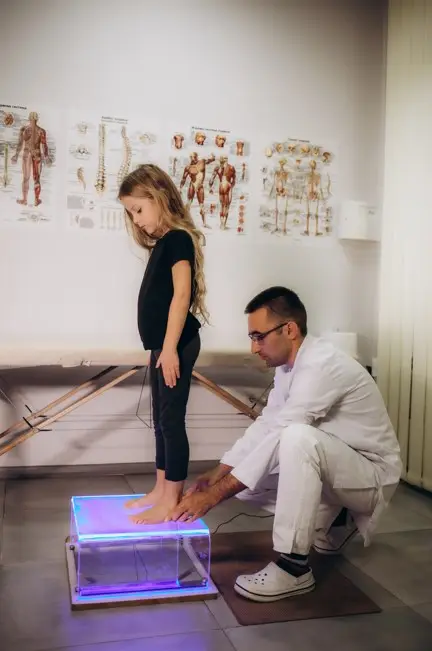
A specialist visit is essential to make a diagnosis .
However, parents can understand if their child has flat feet simply by observing the footprints he leaves barefoot with a wet foot, for example when he gets out of a swimming pool.
Another alternative is to send us at SmartHallux a photo of your child's feet taken from behind while he is standing or a short video of him walking, also taken from behind.
The specialist, simply by observing the patient walking barefoot, is able to define the presence of a pronation syndrome and evaluate the possible presence of a synostosis.
To decide on the patient's treatment plan, the doctor uses an X-ray of both feet while carrying weight. This exam is performed with the patient standing, because standing is where the foot works. Magnetic resonance imaging (MRI) is a test the specialist may request if a synostosis is suspected.
Conservative approach
Pronation syndrome in children is asymptomatic in over 90% of cases and is generally not cured.
One of the most common opinions is that the insole represents the cure for the child's flat foot.
In reality, science has already amply demonstrated that the insole has no therapeutic use, either in the prevention or treatment of pronation syndrome in children.
Pronation syndrome usually affects both feet.
During the growth phase between 8 and 10 years of age, it is important to diagnose any possible pronation syndrome.
In fact, at this stage, it is possible to perform a minimally invasive procedure, which can only be performed during the developmental phase, up to 13 years of age in males and 12 years of age in females.
Surgery for children's pronation syndrome or flat foot
Once symptomatic pronation syndrome or severe pronation syndrome has been diagnosed, it will be possible to intervene with a minimally invasive technique in patients between the ages of 9 and 13.
SmartHallux's goal is to revolutionize the treatment of pronation syndrome and all the most common foot and ankle conditions. To achieve this goal, we adopt the best surgical techniques, orthopedic devices, instruments, and materials available on the market.
We offer private healthcare at an affordable and affordable cost. Unfortunately, public and private healthcare systems have spending limits that limit the use of materials, equipment, and facilities, as well as excessively long waiting times.
With SmartHallux you will have access to the best possible treatments, in excellent facilities and without having to wait for public health authorities.
Surgical techniques have undergone an important evolution compared to the past, starting from anesthesia and post-operative pain control.
The anesthesia we use at SmartHallux for this type of pathology involves sedation combined with local anesthesia. Sedation allows the patient to breathe independently, avoiding the risks of general and spinal anesthesia. It is also minimally invasive compared to other anesthesia techniques, avoiding the use of a catheter, which is sometimes necessary following spinal anesthesia.
The surgery: how it works and how long it lasts
The surgical correction of pronatory syndrome in children (or flat feet) that we perform at SmartHallux exploits the patient's residual growth by inserting an endorthesis, a small screw with a diameter of approximately 8 to 10 mm, into the tarsal sinus.
The tarsal sinus is a small cavity present in all subjects and located between the talus and the calcaneus.
Through a small incision on the outside of the foot (about 1 cm), the endorthesis is inserted inside the tarsal sinus which “guides” the residual growth of the foot, correcting the deformity.
This is a procedure that is performed bilaterally and lasts approximately 3 minutes per side.
At the end of the procedure, two fiberglass casts are made from the knee to the foot, leaving the toes free. At SmartHallux, we currently use a technology that allows us to 3D print custom-made casts for each patient. The child will be able to and must bear weight in these casts starting the day after surgery.
15 days after the operation, the casts are removed and the child gradually returns to walking.
Approximately 1 months after surgery, the patient can return to running, while 3 months after surgery, it is possible to return to contact sports.
The endorthesis is made of a material, titanium, which is perfectly biocompatible and, as such, does not cause allergies or rejection problems, nor does it interfere with MRI scans or cause problems with metal detectors.
When correctly positioned, the endorthesis is generally tolerated by the patient.
Complications and risks of the surgery
The risks and complications associated with surgical correction of children's flat feet are very rare, especially with the minimally invasive surgery we use. They include bleeding, allergic reactions, infections, deep vein thrombosis, embolisms and skin complications, nerve damage with loss of sensation, persistent pain at the scar, joint stiffness, and intolerance to the titanium screw.
Only in 1% of patients is it necessary to remove the endorthesis.
These patients may experience pain or discomfort when landing from a jump or when changing direction.
Removal of the endorthesis is quick, does not cause a loss of correction and after removal the patient can immediately return to daily activities.
How much?
Our doctors, led by Dr. Manzi, have extensive experience treating pronation syndrome in children and adults, with a very high percentage of satisfied patients.
The secrets of our success lie in the use of the best surgical and anesthesiological techniques, and the use of cutting-edge, top-quality materials.
Waiting times for children's flatfoot surgery through the National Health Service (NHS) can be very long, varying from region to region and from facility to facility. In some cases, the wait can be several months or even years. SmartHallux offers the opportunity to access the procedure more quickly, avoiding long waiting lists.
SmartHallux® Certified Clinics
FAQ
Regarding costs, surgical flatfoot correction can vary depending on the technique used, the complexity of the case, and the healthcare facility where it is performed. Typically, the average cost is around €9-€10.000. At SmartHallux, thanks to the advanced technique used and our collaboration with several clinics, we can offer a significantly more competitive price for children's flatfoot correction.
There are several options for booking a consultation with Dr. Manzi.
Dr. Manzi visits medical practices that collaborate with SmartHallux located in Rome, Milan and Naples
It is also possible to book a telemedicine visit.


