
Ankle Prosthesis: What It Is, What It's Used For, and How Many Types Are There?
An ankle prosthesis replaces the worn joint surfaces in severe ankle arthritis when fusion is not the preferred option. What it is, who it suits and the types.
By Dr. Luigi ManziUpdated on
For patients suffering from serious ankle pathologies or trauma, ankle prosthesis often represents the only definitive solution to the problem.
If conservative treatments or various surgical interventions do not restore the correct mobility to the ankle and the resulting serenity to the patient, even expert doctors recommend replacing the joint with an ankle prosthesis.
It is important to know, however, that there are different types of ankle prostheses , which vary both in composition and in the method of intervention.
In this article, we will provide an overview of the different types of ankle prostheses, so that each patient, always under the guidance of a specialist, can be informed and make the right decision.
The different types of ankle prostheses
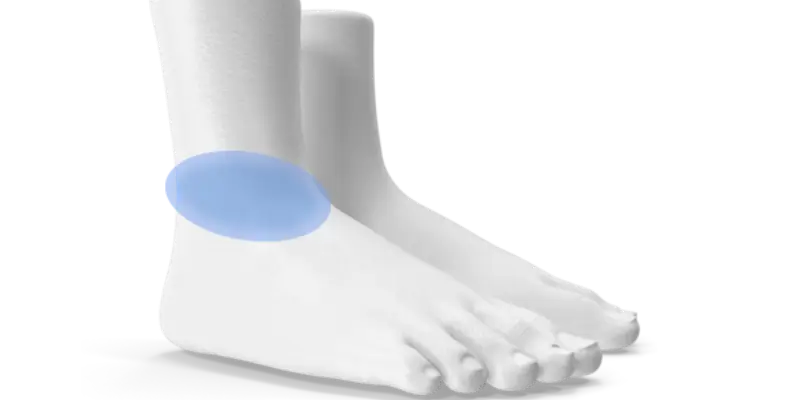
As mentioned, there are different types of ankle prostheses , designed and built to replace all or part of the ankle joint and its functionality.
The main factors that differentiate the types of prostheses are: material , structure and replacement method.
Let's get into the details, then, and discover the most common and widely used types of ankle prostheses.
Two-component prosthesis
These first prostheses are characterised by their structure which comprises two parts.
These main components that make up the prosthesis are:
- tibial: located on the lower part of the tibia;
- astragalus: fixed to the talus, that is, the bone that articulates with the tibia.
These two parts are usually made of metal , such as titanium or cobalt-chrome, with a polyester component attached to the tibial component. Not only are the parts themselves made this way, but also the contact surfaces between the two. This composition, however, allows for good stability and durability , but also limits mobility for some prosthetic models.
Three-component prosthesis
Unlike the first prosthesis, this prosthesis also includes a third element which is a mobile part . This mobile part is called the " polyethylene insert " and is located between the two components : the tibial and the talar.
Thanks to this polyethylene insert, greater mobility is achieved as well as a more balanced distribution of body weight between the talar and tibial components.
Unlike the two-component prosthesis, this three-component one may have a slightly shorter lifespan , due to the easier wear of the polyethylene.
Dual mobility prosthesis
These special and complex prostheses combine the technology of both two- and three-component prostheses, thus having to include a double movement mechanism.
What is meant by double movement?
The double movement involves a first movement between the tibial component and the polyethylene insert , combined with the second movement between the bone insert and the talar component.
One of the advantages of choosing this dual mobility prosthesis is certainly greater mobility compared to other prostheses, as well as good stability.
Cemented prostheses
For example, when you are subject to osteoporosis and therefore the bone quality itself is damaged, it is advisable to opt for cemented prostheses.
These prostheses are made of a special surgical cement that secures the prosthesis to the bone. The special surgical cement is excellent for ensuring the stability and longevity of the implant.
Cementless prostheses
Unlike cemented ones, cementless prostheses , rather than fixing the prosthesis, encourage the natural growth of the bone around the prosthesis itself.
This natural growth is promoted by special porous surface coatings , which serve precisely to facilitate the natural growth of the bone.
Cementless prostheses are recommended for younger patients or those with uncompromised bone quality, as they can guarantee a longer life than other prostheses.
Hybrid prostheses
Like dual mobility prostheses, hybrid prostheses combine elements of cemented and cementless prostheses.
This therefore involves the use of different materials in the same prosthesis.
To give a practical example: in a hybrid prosthesis there could be a cementless talar component (to aid bone integration) and a cemented tibial component (for greater stability).
Thanks to its composition of different materials, the choice of a hybrid prosthesis is advantageous both for the stability it guarantees, for the reduced percentage of the risk of failure of the prosthesis itself, as well as for its easier adaptability due to its hybrid nature.
Customized prosthetics
As the name itself indicates, custom prostheses are studied, designed and created specifically for the patient being treated.
Using 3D scans of the patient's ankle undergoing surgery, customized prostheses will be created that perfectly match the anatomy of the patient's ankle joint.
Being personalized and made to measure for each patient, custom prostheses improve ankle stability and reduce post-operative risks and problems.
Choosing the type of prosthesis

After having listed the various types of ankle prostheses , it will be good to understand how to choose the most suitable one for the problem developed in the joint.
To choose the right ankle prosthesis for your joint problem, there are several factors to take into consideration.
It is worth listing the most important ones, which are:
- The condition of the ankle and the bones of the joint: when the bone damage is very serious or if you suffer from osteoporosis, it would be right to opt for a cemented ankle prosthesis.
- The presence of an associated disease and other pre-existing pathologiesAs with any other procedure or treatment to cure any pathology, the presence of other illnesses or health conditions inevitably influences the choice of the right prosthesis; it is therefore advisable to always consult a doctor to obtain a complete clinical picture of the patient and evaluate the appropriate course of action.
- The patient's lifestyleEvery patient has a different lifestyle, which consequently requires a different level of mobility. Therefore, a prosthesis that reflects each patient's lifestyle needs should be chosen based on their needs. For example, a patient dedicated to physical activity will be more likely to choose a prosthesis that guarantees mobility and durability (such as a cementless prosthesis).
- The patient's age: which always influences any type of intervention; younger patients, for example, with good bone quality, will be advised to choose dual-mobility or cementless prostheses.
All these factors help determine the best ankle replacement option. However, the final decision should always be made with the help and support of a specialist surgeon who will guide the patient throughout the entire process of selection, grafting, and recovery.
SmartHallux and ankle prostheses

When considering ankle replacement surgery, you should consult a medical specialist who can monitor and guide the entire process.
In this, SmartHallux has established itself as a leader in the industry. Thanks to their extensive experience and professionalism, as well as the expert guidance of Dr. Luigi Manzi , SmartHallux's team of specialist surgeons guarantees the highest quality and professionalism a patient could expect.
Many patients who have undergone ankle replacement surgery with SmartHallux report a significant improvement in their health and quality of life.
Thanks to the new technologies used, combined with the utmost commitment of specialists, SmartHallux confirms itself as the best choice for a patient suffering from foot or ankle pathology.
Book your SmartHallux visit

Don't neglect your ankle health and trust SmartHallux now.
Booking your appointment with SmartHallux is quick and easy.
All you have to do is click here and choose the visit option that's right for you.
Stop suffering and start taking care of your ankle health.