
Ankle Surgery: When It's Really Needed and What to Expect
Ankle surgery is considered when pain or instability persists despite conservative care: the procedures, from arthroscopy to fusion, and what to expect after.
By Dr. Luigi ManziUpdated on
Have you ever woken up in the morning with that nagging ankle pain that just won't go away? Or felt like your ankle wasn't holding up as it once did, perhaps after a sprain that seemed to have healed?
These are the signs that often bring patients to my office. Ankle surgery is certainly not the first thing we think of when we're in pain—and thank goodness for that, I'd say! But sometimes it becomes the only way to walk again without pain.
Let's explore together when surgery is actually necessary and what to expect from this type of procedure. Because, as you know, every patient is different and every situation has its own unique characteristics.
When the ankle tells us "enough"

The ankle is an incredibly complex joint. Imagine, it has to support the entire weight of the body and allow us to walk, run, and jump. It's a true feat of engineering, but precisely because of this, it can be prone to various problems.
I've seen patients who've been living with chronic pain for years. "Doctor, I thought it was normal at this age," they often say. No, it's not normal to suffer every day! Chronic ankle pain is one of the clearest signs that something is wrong.
Then there's the issue of limited mobility. If you can no longer climb stairs without holding on to the railing, or if a simple walk becomes a challenge, it might be time to consider surgery. Instability is another important warning sign—that feeling of your ankle suddenly giving way should never be underestimated.
The pathologies I see most often

In my practice, I regularly treat various conditions that may require ankle surgery. Ankle osteoarthritis is very common, especially after age 50 or following trauma that hasn't healed completely.
Achilles tendon ruptures are dramatic. Patients usually come in saying, "Doctor, I was playing soccer and I heard a popping sound, and then I couldn't walk." The Achilles tendon is crucial for propulsion—without a functioning one, sports are out of the question, and even simple daily activities become difficult.
Then there are the consequences of poorly healed fractures. Sometimes a patient tells me, "I broke my ankle years ago. Everything seemed fine, but now it hurts all the time." Ankle fractures are complicated, and if not treated properly, they can leave chronic problems.
Haglund's disease is less well-known but extremely annoying—that bony protrusion behind the heel that makes certain shoes impossible to wear. And that's not even mentioning chronic plantar fasciitis, which doesn't respond to conservative treatments. After months of unsuccessful injections and physical therapy, surgery can be a cure.
How do I know if you need surgery?

When you come to my office, the first thing I do is listen to you. Really listen. You tell me what's hurting you, since when, and in what situations it gets worse.
Then, of course, I examine you. I watch how you walk—it's called gait analysis—and often I can tell a lot from that alone. I test the mobility of your ankle, see if there are any obvious deformities, and check the stability of the ligaments.
X-rays are essential. In some cases, CT scans or MRIs are also necessary to better visualize the soft tissues. But be careful: what we see on the images doesn't always match the symptoms! I have patients with terrible X-rays who are relatively well, and others with minimal changes who are in a lot of pain.
What types of interventions do we do?
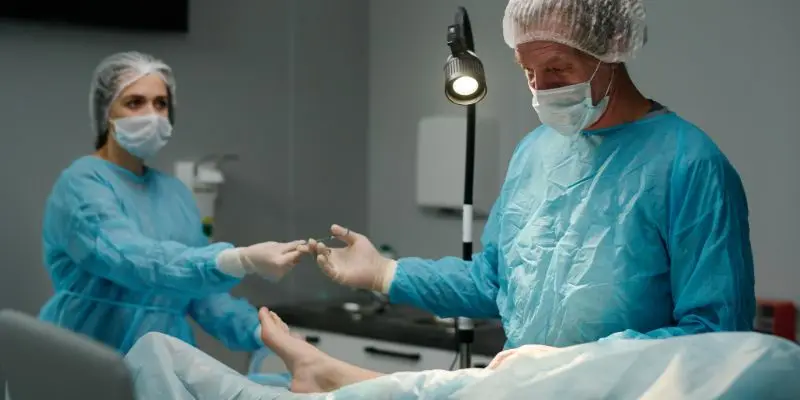
Arthroscopy is wonderful for certain problems. We make tiny holes and, through a miniature camera, we can see inside the joint, clean damaged cartilage, and remove foreign bodies. Recovery times are much faster than with traditional surgery.
For severe osteoarthritis, arthrodesis is sometimes the best option. Yes, it means "blocking" the joint, but when the cartilage is completely worn away and the pain is unbearable, this procedure can restore a normal life. Patients often tell me, "Doctor, I feel no pain anymore and I walk better than before!"
Ankle replacements are becoming increasingly sophisticated. They're still not as common as hip or knee replacements, but in selected cases they provide excellent results. It's a complex surgery that requires specific expertise.
For a torn Achilles tendon, we use different techniques depending on the case. Sometimes a direct suture is sufficient, other times reinforcement with tendons harvested from other areas is needed. Post-operative rehabilitation is crucial—without it, even the best surgery fails.
What to expect after surgery

Be patient. I know it's easy to say, but recovery from ankle surgery takes time. It's not like having appendicitis surgery, where you're all set in a week!
The first few days are the hardest. You'll have to keep your foot elevated, use ice, and take the painkillers I prescribe. Don't worry, it's part of the process. After a few weeks, we'll begin physical therapy—and your cooperation is crucial here.
I have patients who are running again after three months, others who take six months to be 100%. It depends on the type of surgery, your age, how active you were before, and how you follow the post-op instructions.
One thing I always repeat: it's better to go slowly at the beginning and recover well, than to push straight away and ruin everything.
How to avoid having to go to surgery

Fortunately, not all ankle problems end up in the operating room! Surgery can often be avoided with well-executed conservative treatment.
Targeted physiotherapy is often effective. But it must be performed by physiotherapists who are familiar with the anatomy of the foot and ankle—not all are the same, trust me. Hyaluronic acid or cortisone injections can provide lasting relief in many cases.
Then there's the right shoes. You'd be surprised how many problems can be solved simply by changing your footwear! And what about high-impact sports? If you already have ankle problems, perhaps it's better to switch to swimming or cycling.
SmartHallux: Where we can help you

Here at SmartHallux, we specialize in foot and ankle surgery. Dr. Luigi Manzi, with extensive experience in this field, provides each patient with a personalized treatment plan using the most advanced techniques, from minimally invasive arthroscopy to state-of-the-art prostheses.
What sets us apart is our approach: we always first assess whether surgery is truly necessary. We're not "easy-knife surgeons"—surgery is the last option, not the first.
The SmartHallux team treats conditions such as hallux valgus , Morton's neuroma , and other deformities that cause foot pain. Providing comprehensive support throughout the treatment process, SmartHallux can be a winning choice for effective treatment tailored to your needs. Book your specialist consultation with the SmartHallux team now (opens in a new tab).
Questions you often ask me
Doctor, how much does ankle surgery cost?
Costs vary greatly depending on the type of procedure and the facility. For a medium-complexity procedure, we're talking about €9-€10.000. But the important thing is that here at SmartHallux, we work with several clinics to offer competitive prices without compromising quality.
Will I ever be able to play sports again?
It depends on your sport and the type of surgery. Those who swim or cycle usually return to their previous activities without any problems. High-impact sports like soccer or tennis require a case-by-case evaluation. The important thing is not to rush.
Is it true that after surgery the ankle is still a little stiff?
Not necessarily. With proper rehabilitation, many patients regain near-normal mobility. Of course, if we perform an arthrodesis, mobility will inevitably be limited, but it's often an acceptable compromise for eliminating pain.