
Ankle Surgeon: When Pain Limits Your Life
Dr. Luigi Manzi, orthopedic foot and ankle surgeon: when ankle pain or instability calls for a specialist and the minimally invasive options.
By Dr. Luigi ManziUpdated on
Does your ankle hurt? Can't walk as well as you used to?
I completely understand. In my office, I see people limping every day, perhaps after months or even years of pain they've endured, hoping "it would go away on its own." The ankle, after all, is a complex joint—much more so than people think—and when it gets damaged, it really gets damaged.
I'm Dr. Luigi Manzi, an orthopedic ankle surgeon specializing in foot and ankle surgery. Over the years, I've come to understand one thing: ankle pain isn't just a nuisance. It's something that changes your life, keeping you from doing the things you love, making you avoid stairs, forcing you to give up walks. And often, when conservative treatments are no longer enough, surgery is the solution.
When the Ankle Says Enough

The ankle is like a door hinge. It works great as long as everything is aligned and in order, but as soon as something gets twisted... that's when the trouble begins.
Have you ever woken up in the morning and felt like your ankle was stiff as a stick? Or felt a sharp pain when you put your foot down after sitting for a while? This happens because the joint, when compromised, can no longer move smoothly.
My patients often tell me the same story. "Doctor, at first it was just a nuisance after walking a lot. Then it became constant pain. Now I can't even go grocery shopping comfortably." And they're right to be concerned, because ignoring the problem often makes it worse.
The Causes? More Common Than You Think

Why does my ankle get damaged? There are many reasons, and it's not always the result of an obvious injury.
Of course, poorly treated sprains are a common cause. How many times have I heard: "I sprained my ankle playing soccer twenty years ago, but I never did anything because it seemed healed." Well, that's exactly the problem. A poorly treated sprain can lead to chronic instability and, over time, osteoarthritis.
But it's not just a matter of trauma. Ankle arthritis can also develop due to wear and tear, especially if you've done heavy work or high-impact sports for many years. Haglund's disease, on the other hand, is that bony protrusion behind the heel that rubs against the shoe and causes terrible bursitis.
And then there are Achilles tendon ruptures. That's a nasty beast—it feels like a crack, like someone hit you with a club. I've seen it happen even to people who were just running to catch the bus.
Symptoms You Shouldn't Ignore
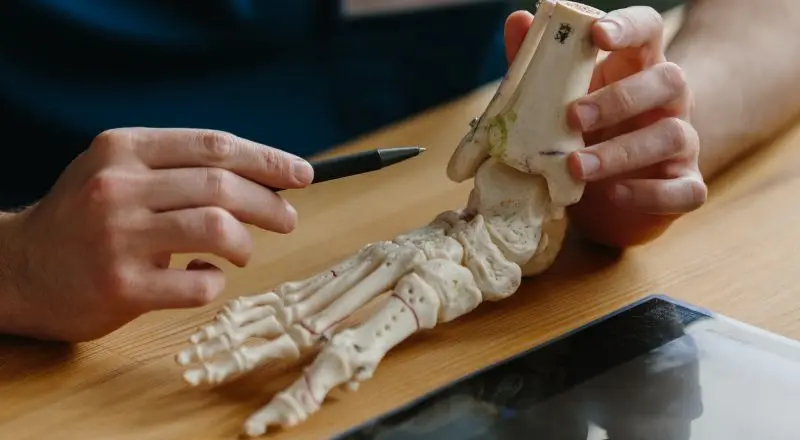
Pain is obviously the first warning sign. But it's not just that.
When I examine a patient, I always look at how they walk even before they sit down. Often, there's that way they place their foot that says it all: "I'm avoiding putting weight on that area because it hurts." Then there's the swelling—maybe not always present, but it appears after walking or in the evening.
Morning stiffness is another important sign. "Doctor, when I get out of bed, the first few steps are terrible, then it slowly gets a little better." This tells me the joint is inflamed and needs to "warm up" to function.
And then there's the instability. That feeling that your ankle is slipping away when you walk on uneven ground or climb stairs. It's as if you no longer trust your foot.
How I Understand What's Wrong

When you come to my studio, the first thing I do is listen to you. Really.
I'll ask you to tell me when the problem started, what makes it worse, what makes it better. Then I'll watch you walk—it's amazing how much information you can glean simply from observing how a person moves.
The physical exam comes next. I check where it hurts when I press, how much you can move your ankle, and whether there are any swollen or warm areas. Often, by this point, I already have a pretty good idea of what's going on.
X-rays are essential for assessing the condition of bones and joints. Sometimes an MRI is also necessary, especially if I suspect ligament or tendon problems. "But doctor, is it really necessary?" Look, if I have to operate on you, I want to know exactly what I'm dealing with. It's like trying to fix an engine without opening the hood.
Treatment Options: Not Just Surgery

Not everything can be solved with a scalpel, let's be clear.
Whenever possible, I always try conservative treatments first. Specialized physiotherapy, injections, and custom-made insoles. I've seen ankles "resurrect" with a good, targeted rehabilitation program. But I have to be honest: when arthritis is advanced or the ligaments are completely compromised, surgery is often the only way to return to pain-free living.
Ankle surgery today is not what it used to be. We have minimally invasive techniques that significantly reduce recovery times. For severe arthritis, we can perform arthroscopy to "clean" the joint, or in more severe cases, an ankle replacement—yes, just like a knee or hip replacement.
For Achilles tendon ruptures, we've developed innovative techniques. Here at SmartHallux, we also use stem cells to accelerate healing—a technique that has yielded truly impressive results.
Recovery: What to Really Expect

“Doctor, when will I be able to walk normally again?” This is the question everyone asks me.
The answer depends on the type of surgery, but I can tell you that recovery times today are much quicker than in the past. For a simple arthroscopy, patients are often back to walking without crutches within a week. For more complex procedures, a little more patience is required.
The important thing is to follow the rehabilitation program. I know it's boring to do exercises every day, but believe me: it makes the difference between a complete and a partial recovery. I've seen patients who had perfect surgery who didn't recover well because they didn't do physical therapy, and others who came back better than before thanks to their commitment to rehabilitation.
How to Prevent Ankle Problems

Prevention is always better than cure – a cliché, but a true one.
If you play sports, always wear appropriate footwear and never ignore a sprain, even if it seems minor. Apply ice immediately, rest, and if it still hurts after 48 hours, see a specialist.
If you work on your feet all day, try to take breaks and stretch. Your ankle needs movement to stay healthy. And if you have weight issues, consider that every extra pound puts additional strain on your joints.
SmartHallux: Where We Can Help You

I have gained specific experience in this field, and each patient is treated with a completely personalized approach using the most modern techniques available.
The SmartHallux team treats conditions such as hallux valgus , Morton's neuroma , and other deformities that cause foot pain. Providing comprehensive support throughout the treatment process, SmartHallux can be a winning choice for effective treatment tailored to your needs. Book your specialist consultation with the SmartHallux team now (opens in a new tab).
Our philosophy is simple: to make foot and ankle surgery accessible to everyone, with short wait times and cutting-edge technology. We have centers throughout Italy for initial visits, and we also offer telemedicine consultations for those unable to travel.
FAQ
Doctor, how long do I have to wait for surgery in a private clinic?
Here's one of the most frequently asked questions. At a private clinic like ours, waiting times are dramatically reduced. We can often schedule the procedure within a few weeks of the appointment, not months like in public clinics. Our staff is highly qualified, and we use cutting-edge technology to ensure optimal results.
What are the advantages of private surgery for an ankle problem?
The advantages are tangible: reduced time, personalized care, and modern technology. But above all, my team and I can dedicate as much time as necessary to each patient, from the initial consultation to post-operative follow-up.
How can surgery really improve my quality of life?
I always tell my patients: the goal isn't just to relieve pain, but to get you back to doing what you love. Whether it's walking without worries, going back to running, or simply getting out of bed without pain. Modern ankle surgery can truly restore your freedom of movement.