
Foot tumor: what you need to know without alarm
A foot tumor is rare and more often benign than malignant: lumps, cysts and bone lesions. The warning signs, the tests used and when to see a specialist.
By Dr. Luigi ManziUpdated on
When you hear the word "foot cancer," it's natural for alarm bells to go off. I completely understand. In my office, I've seen so many worried faces from patients who arrive with this fear. But let's take a deep breath and see what we're really talking about.
Fortunately, foot tumors are quite rare. And when they do occur, most are benign—that is, they don't metastasize and aren't life-threatening. This doesn't mean they should be ignored, quite the opposite. But it does mean we can approach the issue with the right amount of care and avoid panic.
What exactly is foot cancer?

When we talk about tumors, in medicine we mean an abnormal growth of tissue. In the foot, this can affect various structures: skin, bones, muscles, nerves, blood vessels. It's as if some cells decided to "do their own thing" and began to multiply in a disorderly fashion.
The good news? The vast majority of foot tumors I see are benign. Cysts, lipomas, fibromas… stuff that sounds scary but, in reality, is more of a nuisance than a threat. I've had patients who lived with small benign tumors for years without even knowing it.
But be careful—and this is important—malignant forms also exist. Melanoma, for example, can also develop on the sole of the foot. In fact, foot cancer can be particularly insidious because it is often mistaken for something else.
Why do these tumors form?
Well, this is one of those questions I'm always asked, and to which, honestly, we can't always give a definitive answer. We know some factors well. Sun exposure, for example, can increase the risk of melanoma on the feet—yes, even on the soles, even if we don't expose them directly. Who would have thought?
Smoking is another general risk factor. Repeated trauma to certain areas can predispose to certain types of cancer. Age plays a role—after 50, the likelihood increases slightly. But truth be told, it often happens this way, for no apparent reason.
I've seen young athletes with small benign tumors and sedentary elderly people with nothing. Biology, sometimes, has its own mysterious logic.
Signs You Shouldn't Ignore

So, what should you watch out for? Pain is often the first warning sign, but not always. It may seem strange, but some foot tumors don't hurt at all, especially at first.
Swelling is another sign. I'm not talking about the kind you get after a day on your feet, but persistent swelling, perhaps affecting just one foot or a specific area. The other day, a patient came to see me who noticed his left foot was increasingly swollen compared to his right, for no apparent reason.
A lump you can feel under the skin. Something that wasn't there before. Maybe it's small, maybe it moves when you press it, maybe it's fixed. Anything can be significant. Persistent redness in an area, especially if accompanied by localized heat, always warrants a checkup.
And then there's the loss of sensation. If a tumor grows and presses on a nerve, you may start to feel tingling, numbness, that strange "sleepy foot" sensation in certain areas. Morton's neuroma, for example, can cause similar symptoms.
One thing I always tell my patients: you know your feet better than anyone. If you notice anything different, strange, or that doesn't go away after a few weeks, come and have me take a look.
How do we arrive at the diagnosis?

When you come to my office with these concerns, the first thing I do is look at your feet. It seems trivial, but a clinical eye counts. I look, touch, and compare one foot with the other. I ask you how long you've been noticing the problem, if it hurts, and if it's changed over time.
Then, if necessary, we order tests. X-rays are often the first step—they tell us if the bone is involved. But for soft tissue, we need something more sophisticated: ultrasound, MRI, sometimes CT scans.
A biopsy is the gold standard when it comes to cancer. We take a small piece of tissue and send it to the pathologist. He's the one who tells us with certainty what it is. It sounds scary, but I assure you that in most cases it's a simple procedure, done in an outpatient setting.
What are the treatment options?
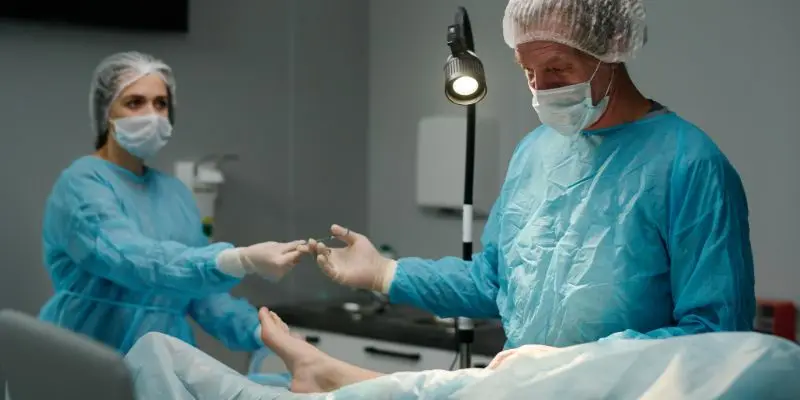
It all depends on what we find. For benign tumors, surgical removal is often the solution. This is a procedure that, in most cases, can be done as a day surgery. You come in in the morning, and leave in the afternoon.
For malignant forms, things get more complicated. A multidisciplinary approach with an oncologist may be necessary. Chemotherapy, radiation therapy, more extensive interventions. But even here, if caught early, the chances of success are excellent.
I've treated patients who, after the removal of a small melanoma on their feet, have resumed their normal lives without any problems. The important thing is not to waste time when you suspect a problem.
Recovery times and what to expect
Typically, after surgery for a benign tumor, you can walk normally again within a few weeks. Of course, it depends on the area operated on and the extent of the procedure. A small lipoma removed from the top of the foot will keep you much less immobile than a bone cyst requiring a graft.
In more complex cases, rehabilitation can last a few months. However, the vast majority of my patients return to normal activities without any particular limitations.
Can it be prevented?
I can't tell you there's a magic recipe for preventing foot cancer. But there are some sensible precautions. Check your feet regularly, especially if you have moles or spots that change color or shape. Protect your feet from the sun when you're at the beach—yes, even the soles can get sunburned and damaged.
Don't smoke. I know, it seems obvious, but smoking increases the risk of cancer practically everywhere. Wear appropriate footwear to avoid repeated trauma to sensitive areas.
SmartHallux: Where we can help you

Here at SmartHallux, we specialize in foot and ankle surgery. Dr. Luigi Manzi, who has extensive experience in this field, provides each patient with a personalized treatment plan using the most modern techniques. When it comes to foot tumors, surgical precision and experience make the difference.
The SmartHallux team treats conditions such as hallux valgus , Morton's neuroma , and other deformities that cause foot pain. Providing comprehensive support throughout the treatment process, SmartHallux can be a winning choice for effective treatment tailored to your needs. Book your specialist consultation with the SmartHallux team now (opens in a new tab).
Questions you often ask me
Doctor, do all foot tumors hurt?
No, not all. Some, especially initially, are completely painless. This is what makes them sometimes insidious. Pain may appear as they grow or when they begin to compress nerves or blood vessels.
How do I know if it's serious?
It's difficult to do it alone. Any persistent changes in your foot that don't go away within 2-3 weeks deserve a specialist evaluation. Don't self-diagnose online; come and see a doctor.
If it's benign, do I really have to remove it?
Not always. If it's small, doesn't bother you, and doesn't grow, sometimes you can just keep it under control. But every case is different—it depends on the location, size, and type of tumor.