
Talus fracture: symptoms not to be ignored
A talus fracture follows a fall or a sports injury and causes intense ankle pain that is easy to mistake for a sprain. The symptoms, diagnosis and treatment.
By Dr. Luigi ManziUpdated on
Have you ever heard of the talus? Probably not. It's one of those little bones in the foot that no one remembers... until it breaks. And when it does, believe me, you definitely notice.
The other day, a patient came to me after taking a nasty fall during a soccer game. "Doctor, my ankle hurts like hell, but I don't understand why." Well, that intense pain you can't explain could actually be a talus fracture. It's a more common injury than you think, especially among athletes.
What exactly is astragalus and why is it so important?
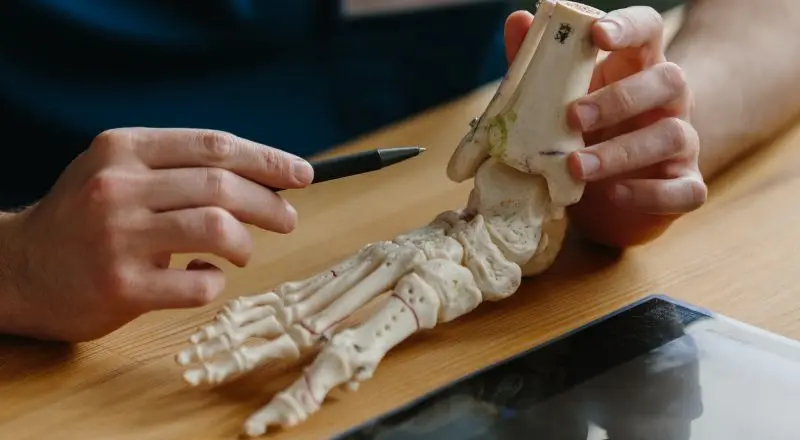
The talus is a small bone located just above the heel bone, at the back of the foot. Think of it as the "pivot" around which the entire ankle rotates: without it, you couldn't make those fluid movements when walking or running.
It's a unique bone. Truly unique. Most of its surface is covered in cartilage, which means it receives very little direct blood flow. That's why when it fractures, the problems can be more complicated than with other bones in the body. It's as if it were a somewhat "isolated" piece of our skeleton.
Fractures can be of different types: some are simple cracks, others are compound fractures where the fragments shift, and in the worst cases, we have comminuted fractures where the bone breaks into multiple pieces. This last type, I'll tell you right away, is the one that worries me the most when I see it on X-rays.
How do you break the talus?
The question everyone asks me is: “But how did I break it?” The causes are fairly typical, and after years of experience I can almost guess the dynamics of the accident even before the patient tells me.
The most common injuries are falls from heights. We're not talking about falls from skyscrapers, mind you: even falling from a two-meter ladder can be enough. The problem is how you land: if your foot hits the ground in a forced position, with the ankle bent too much, the talus can buckle under the weight of the impact.
Car accidents are another common cause, especially when there's a frontal impact and the foot gets stuck against the pedal. I've seen several such cases over the years. High-impact sports can also cause this type of fracture: soccer, basketball, skiing... all sports where the ankle can be subjected to sudden and violent twisting.
There's also an interesting thing I've noticed: statistically, it affects men more than women, and primarily in the 20- to 40-year-old age group. Probably because that's the age when people are more active and take more risks.
The symptoms you need to recognize right away

When a patient comes to my office with a talus fracture, the symptoms are quite obvious. Pain is the first thing that stands out: a sharp, deep ache that worsens when you try to put weight on the foot or move the ankle.
Swelling occurs almost immediately. The ankle swells noticeably, and a hematoma often appears, which can extend to the foot. It's not just a bruise: it's a swelling that pulls, giving that tight feeling that many patients describe as "an ankle about to explode."
Deformity is another sign that can't go unnoticed. The ankle may appear "twisted," out of alignment with the leg. If you notice that the profile of your ankle is different than usual, it's time to rush to the emergency room.
One thing that always strikes me is how patients describe their inability to walk. "Doctor, I just can't put weight on my foot." It's different from the pain of a simple sprain: here you just can't physically support your weight.
Some patients also report a feeling of instability, as if the ankle were "bouncing." Others hear strange noises when they try to move their foot, a sort of creaking sound that we technically call crepitus. This is never a good sign.
How do I make the diagnosis in the office?

When I suspect a talar fracture, my approach is always the same. First, I look at the patient's gait: they often arrive with a noticeable limp or even on crutches.
A physical examination is essential. I gently palpate the area to identify the areas of greatest pain, check circulation in the foot, and verify there is no nerve damage. Then I ask the patient to move the ankle: if there is a fracture, movement is limited and painful.
But the X-ray always gives me certainty. I usually ask for multiple projections to see the bone from different angles. Sometimes, however, talus fractures are subtle and can't be seen clearly with a simple X-ray.
In these cases, I don't hesitate to request a CT scan. The CT scan allows me to see exactly where the fracture is, how many fragments there are, and whether the bone has shifted. In some specific cases, I also request an MRI scan to evaluate the surrounding soft tissue.
Early diagnosis is crucial. The longer it takes, the greater the risk of complications, especially what we doctors call avascular necrosis—essentially, bone "dying" from lack of blood.
The treatment options we have available

Treatment depends greatly on the type of fracture. I'll tell you right away: not all talus fractures are the same, and therefore, neither are the treatments.
For simpler fractures, those we call "displaced" (where the bone is broken but the fragments are still in place), we can sometimes try conservative treatment. This involves a cast and complete rest for 6-8 weeks. But be careful: this only applies to very select cases.
In most cases, however, surgery is necessary. The procedure we perform most frequently is open reduction with internal fixation: we open the bone, replace the pieces, and secure them with titanium screws or plates. It's a delicate procedure that requires specific expertise.
In more severe cases, when the bone is severely damaged, we may need to resort to arthrodesis—essentially "blocking" the joint to eliminate the pain. It's not the ideal solution, but sometimes it's the only one that works.
Recovery time? It depends. After surgery, it usually takes at least three months before you can walk normally again. Rehabilitation is essential: physiotherapy, range-of-motion exercises, and muscle strengthening. It's a long but necessary process.
What can go wrong: complications
This is the part I prefer not to have to explain to patients, but it's important for you to know. Talus fractures can cause serious complications.
The most feared is avascular necrosis: the bone stops receiving enough blood and begins to die. When this happens, further surgery is often necessary, sometimes even an ankle replacement.
Infection is always a risk when we operate, especially if the fracture is exposed (with broken skin). For this reason, we always use preventative antibiotics.
Post-traumatic osteoarthritis is almost inevitable: articular cartilage wears down more quickly after such an injury. It doesn't always cause symptoms, but it should be monitored.
The good news? With timely diagnosis and appropriate treatment, most patients return to a normal life. They may no longer become professional soccer players, but walking, running, and participating in recreational sports are absolutely possible.
How to prevent these fractures

Preventing a talus fracture isn't always possible, especially when it's caused by car accidents or accidental falls. But there is something we can do.
If you practice high-risk sports, always use appropriate protective gear. Wear the right shoes, wear ankle braces if necessary, and above all, never ignore your body's signals. An ankle that hurts or swells frequently may be more fragile than normal.
At work, if you use ladders or work at heights, always follow safety rules. I know it seems obvious, but most accidents at home happen due to haste or carelessness.
Maintain good physical fitness: strong muscles around the ankle help prevent injury. And if you've had ankle problems in the past, don't ignore them: an unstable ankle is more likely to fracture.
SmartHallux: Where we can help you

Here at SmartHallux, we specialize in foot and ankle surgery. Dr. Luigi Manzi, who has extensive experience in this field, provides each patient with a personalized treatment plan using the most modern techniques.
Our approach is always multidisciplinary: we don't limit ourselves to surgery, but we support you throughout the entire recovery process, from diagnosis to complete rehabilitation.
The SmartHallux team treats conditions such as hallux valgus , Morton's neuroma , and other deformities that cause foot pain. Providing comprehensive support throughout the treatment process, SmartHallux can be a winning choice for effective treatment tailored to your needs. Book your specialist consultation with the SmartHallux team now (opens in a new tab).
Questions you often ask me
Doctor, but how do I know if it's a fracture or a sprain?
The difference lies in the intensity of the pain and the ability to walk. With a sprain, even though it hurts, you can usually put some weight on your foot. With a talus fracture, that's virtually impossible.
Will I go back to playing sports like before?
In most cases, yes, but it takes patience. Returning to sports is gradual and must always be supervised by a physical therapist. This usually takes at least six months after surgery.
Is it true that these fractures heal worse than others?
Unfortunately, yes, the talus has a unique vascular system that makes healing slower and more complex. This is why early diagnosis and appropriate treatment are so important.
Will I always feel pain after a fracture like this?
Not necessarily. Many patients return to a completely normal life. Others experience some occasional discomfort, especially with changes in weather. It depends greatly on the type of fracture and how it was treated.