
Enthesopathic calcification of the hip: when tendons become "crusted"
Enthesopathic calcification of the hip is a build-up of calcium where tendons attach to the bone, causing groin pain that lingers. The causes and treatment.
By Dr. Luigi ManziUpdated on
You know, the other day a 45-year-old patient, an avid runner, came to me. "Doctor, I have this groin pain that won't go away." I see cases like this all the time. Enthesopathic calcification of the hip is one of those conditions that may initially seem like a simple muscle discomfort, but actually hides something more complex.
We're talking about calcium deposits that form in the tendons around the hip joint. It's not the stuff of science fiction—it's more common than you think. The problem is that it's often overlooked or confused with other conditions.
But what exactly is this calcification?
Think of the enthesis as the point where a tendon meets a bone. It's an area of great mechanical stress. Calcific enthesopathy of the hip occurs when calcium crystals begin to deposit at these points.
Why does this happen? Our body sometimes reacts to repeated microtrauma by depositing calcium where it shouldn't. It's as if it's trying to "strengthen" an area it perceives as weak or damaged. However, this strengthening can create more problems than it solves.
The age group most affected? Generally between 40 and 60. Women appear to be slightly more susceptible, especially during the perimenopausal period.
The causes: more complex than they seem

There's no single cause. After all, the human body is never that simple.
Repetitive microtraumas are the most common trigger. Think of athletes who run on asphalt for years, or those who work jobs that require repetitive hip movements. Joint overload can be subtle—you don't realize you're overdoing it until it's too late.
Arthritis can be another cause. When the joint is chronically inflamed, the surrounding tissues are affected. It's a vicious cycle: inflammation promotes calcium deposits, which in turn maintain inflammation.
Autoimmune diseases play a significant role. I've seen patients with rheumatoid arthritis develop multiple calcifications. The rampaging immune system also attacks the entheses.
And then there are genetic factors. Some families seem to be more predisposed. It's not that you inherit calcification, but you inherit the tendency to develop it.
Symptoms: What patients tell me
"Doctor, it hurts especially when I get up from a chair." I hear this all the time. Groin pain is the main symptom, but it can radiate to the side or thigh.
Morning stiffness is typical. You wake up and feel like your hip is locked up. After a little movement, it gets better, but the stiff feeling remains. Some patients tell me they walk like penguins for the first ten minutes of the day.
The pain to the touch is characteristic. If I press on the inflamed enthesis area, the patient jumps in his chair. It's a very precise, pinpoint pain.
Everyday activities become a problem. Climbing stairs, getting into the car, tying your shoes—simple gestures that become a source of pain.
How I get to the diagnosis
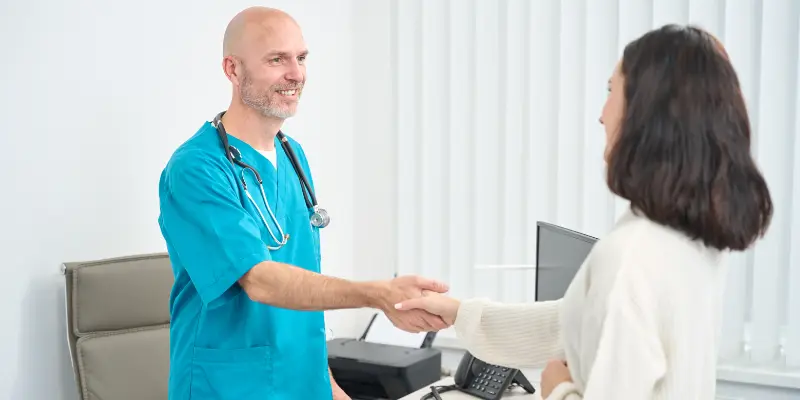
First of all, I listen. Your medical history is crucial. I'll ask you about your lifestyle, work, and sports activities. Often, your medical history already tells me a lot.
The physical examination comes next. I check the hip's movements, look for tender points, and assess joint mobility. There are some specific tests I use to tension the entheses and see if they cause pain.
An X-ray is the first test I order. Calcifications are easily visible; they appear as small white "clouds" near the bone. However, they aren't always visible in the early stages.
Ultrasound is fantastic for these types of problems. I can see the soft tissue in real time, assess tendon thickness, and even detect small calcifications that X-rays might miss.
I use MRI in cases of doubt or when I suspect associated problems. It provides detailed information on all the soft tissues of the hip.
Treatment options: what can we do?

Rest is always the first step. I know it's frustrating to hear the words "rest," but sometimes it's necessary. It doesn't mean staying still, but avoiding activities that cause pain.
Anti-inflammatory drugs help, but they don't address the underlying problem. I use them to control acute symptoms while we address the underlying cause.
Physiotherapy is essential. Stretching and muscle strengthening exercises help rebalance the forces acting on the hip. I've seen significant improvements with a well-structured physiotherapy program.
I reserve corticosteroid injections for the most resistant cases. They can provide significant relief, but they're not a long-term solution.
For more challenging cases, there are innovative therapies such as extracorporeal shock waves. They help break down calcium deposits and stimulate tissue repair.
Surgery? It's the last resort. Arthroscopy allows for the minimally invasive removal of calcific deposits, but I reserve it only for cases that don't respond to any other treatment.
The recovery journey

Every patient is different. Some improve in a few weeks with rest and physical therapy, while others require months. Patience is key.
During rehabilitation, exercises should be done gradually. Begin with gentle movements and progress slowly. The goal is to restore mobility without causing new inflammation.
I often tell my patients: "Don't rush." Inflamed tissue needs time to heal. Forcing it often means repeating the problem.
Prevention: better than any cure

Avoiding overload is essential. If you play sports, listen to your body. Vary your workouts, don't always do the same movements.
Body weight matters. Every extra pound puts additional stress on your joints. Maintaining a healthy weight is one of the best investments in joint health.
Stretching exercises should be a daily routine. Spend ten minutes a day maintaining hip flexibility.
SmartHallux: Where we can help you

Here at SmartHallux, we specialize in foot and ankle surgery. Dr. Luigi Manzi, who has extensive experience in this field, provides each patient with a personalized treatment plan using the most modern techniques.
The SmartHallux team treats conditions such as hallux valgus , Morton's neuroma , and other deformities that cause foot pain. Providing comprehensive support throughout the treatment process, SmartHallux can be a winning choice for effective treatment tailored to your needs. Book your specialist consultation with the SmartHallux team now (opens in a new tab).
Questions you often ask me
Doctor, can calcification reabsorb on its own?
Yes, it can happen. Not always, but in some cases, calcium deposits reabsorb spontaneously. It depends on their size, location, and how long they've been present. For this reason, we often begin with conservative therapies.
Is it true that it depends on age?
Age is certainly a factor. As we age, tissues lose elasticity and are more prone to degenerative processes. But it's not a death sentence—I've seen seventy-year-olds with perfect entheses and forty-year-olds with multiple calcifications.
Should sports be avoided completely?
Absolutely not. You need to modify, not eliminate. If you run, perhaps reduce your mileage and run on softer surfaces. If you play tennis, perhaps avoid the hardest shots until you feel better. The important thing is not to worsen the inflammation.
How long does it take to heal?
This is the question you all ask me. The honest answer is: it depends. In mild cases, 4-6 weeks may be enough. In more complex cases, it can take up to 3-4 months. The important thing is to be consistent with treatment.